
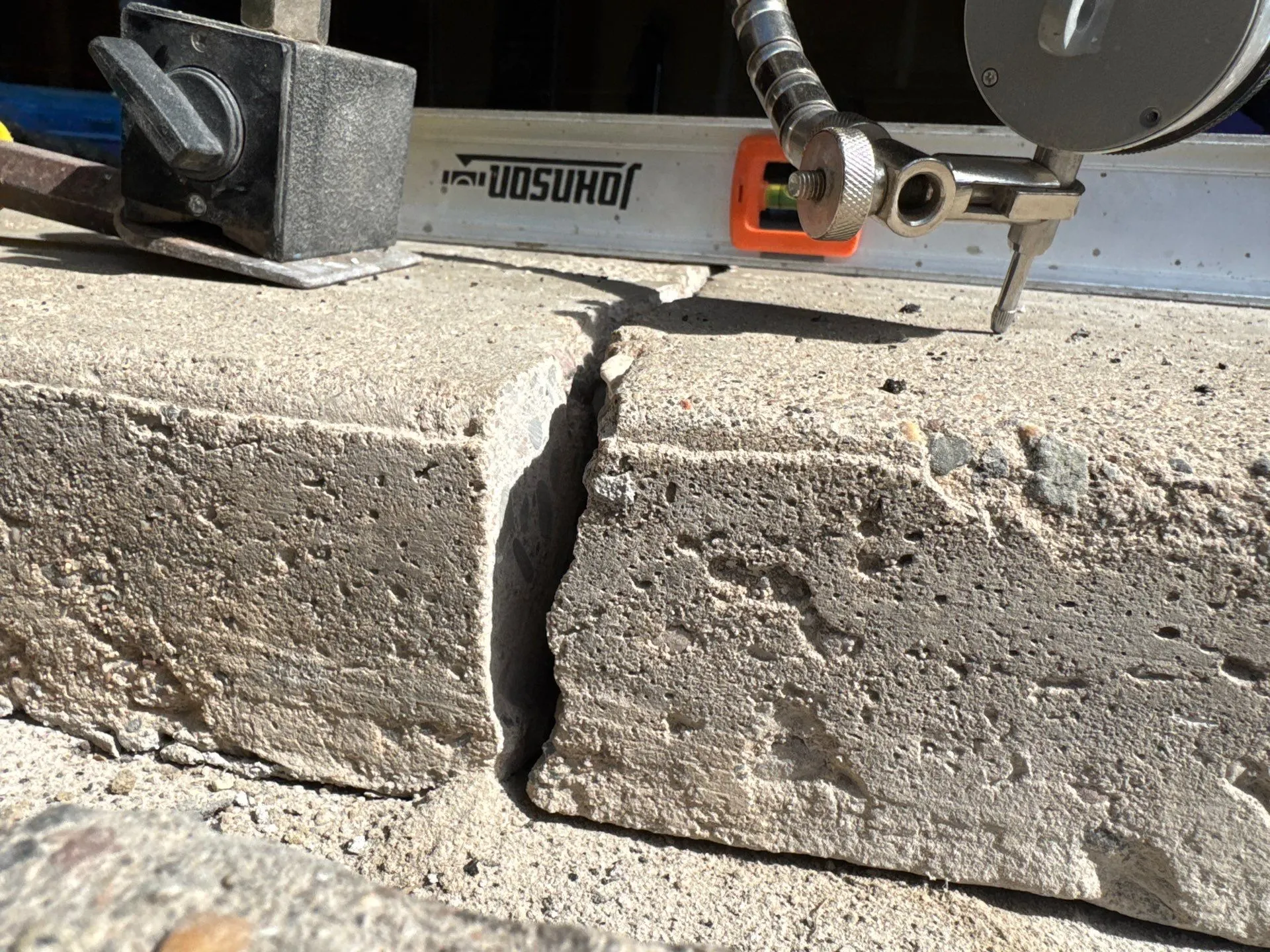
What is concrete lifting?
Concrete lifting, also called concrete raising, foam jacking, polyjacking, or slabjacking, restores a sunken slab without replacing it. We drill dime-sized holes through the concrete, inject expanding polyurethane underneath, and the foam fills the empty space below the slab before lifting it back to grade. The foam cures in about 15 minutes, holds its shape permanently, and does not wash out or absorb water. The older version of this trade, mudjacking, pumps a heavy sand-cement slurry through much larger holes. It weighs down the same soil that already failed. Polyurethane weighs a fraction as much, which is why it has largely replaced mud in Minnesota.
Raising a sunken concrete driveway
Driveways are the most common lift we do. The slab next to the garage settles first because backfill around the foundation keeps compacting for years after construction, and downspouts concentrate water right where the slabs meet. You see the gap at the garage apron, water pooling against the slab edge, and a lip that catches snow shovels and tires. We raise the settled panels, match them to the garage floor line, and seal the joints so meltwater stops feeding the problem underneath.
- Garage aprons and approach slabs matched back to the floor line
- Mid-driveway panels raised so water sheds instead of pooling
- Joints and cracks sealed after the lift to keep the base dry
Lifting, leveling, or replacement?
Lifting and leveling are the same operation described from different angles: we lift a slab in order to level it. Replacement is the option worth questioning. Tearing out and repouring costs several times more, closes the surface for days of cure time, and puts new concrete on the same unstable base that sank the old slab. Lifting reuses your existing concrete, takes hours instead of weeks, and treats the cause by filling the voids below. When a slab is shattered, badly spalled, or has sunk past the point of recovery, we say so and recommend replacement instead of selling a lift that will not hold.
Why homeowners pick us for concrete lifting
- Slabs raised back to grade in hours, drivable the same day
- Dime-sized injection holes instead of tear-out demolition
- Foam cures in about 15 minutes and never washes out
- Lightweight material that does not overload settled soil
- A fraction of the cost of pouring new concrete
- Same crew and chemistry as our insulation division
How the job runs
- Step 1 of 4
Inspect and measure
We check the slab, find the voids, and shoot the elevations so we know exactly how far each panel needs to come up.
- Step 2 of 4
Drill
A few dime-sized holes go through the slab at planned lift points. No trenching, no landscaping damage.
- Step 3 of 4
Inject and lift
Expanding polyurethane fills the void and raises the slab in controlled passes, checked against a level line as it moves.
- Step 4 of 4
Patch and seal
Injection holes get patched to match, joints get sealed, and we walk the finished lift with you before we leave.
What does concrete lifting cost in the Twin Cities?
The price of a lift depends on how far the slab has settled, how large the void underneath is, and how many panels need to come up, not on the square footage alone. A garage apron that dropped an inch costs far less than a full driveway that settled across every joint. What stays constant: lifting runs a fraction of what replacement costs, because you keep your existing concrete and skip demolition, hauling, and new pours. We measure on site and quote a firm number for free.
Fair questions, straight answers
Is concrete lifting worth it?+
Usually, yes. Lifting costs a fraction of replacement, takes hours instead of weeks, and fixes the void that caused the settling. It stops being worth it when a slab is shattered or badly deteriorated, and we tell you that at the estimate instead of lifting concrete that cannot hold.
How is concrete lifting different from mudjacking?+
Both raise sunken slabs, but mudjacking pumps heavy sand-cement slurry through holes the size of a soda can. Polyurethane lifting uses dime-sized holes and a foam that weighs a fraction as much, cures in minutes, and never washes out. The lighter material does not re-compress the soil that already failed.
How soon can I drive on lifted concrete?+
The same day. The foam reaches most of its strength in about 15 minutes, so a driveway lifted in the morning is holding vehicles by the afternoon. Joint sealant applied after the lift needs longer to set, so we may ask you to keep water off the joints briefly.
Will the slab sink again after lifting?+
The foam itself does not shrink, wash out, or absorb water, so the lift holds. What can change is the ground nearby: new erosion from an unaddressed downspout can undermine a different slab edge. That is why we seal joints and point out drainage problems while we are on site.
Can you lift concrete in winter?+
Cold-weather lifts are possible, but frozen ground complicates them, and a slab heaved by frost needs to settle back before a lift means anything. If you call in January we will tell you honestly whether to lift now or wait for the thaw, and get you on the spring schedule early.