
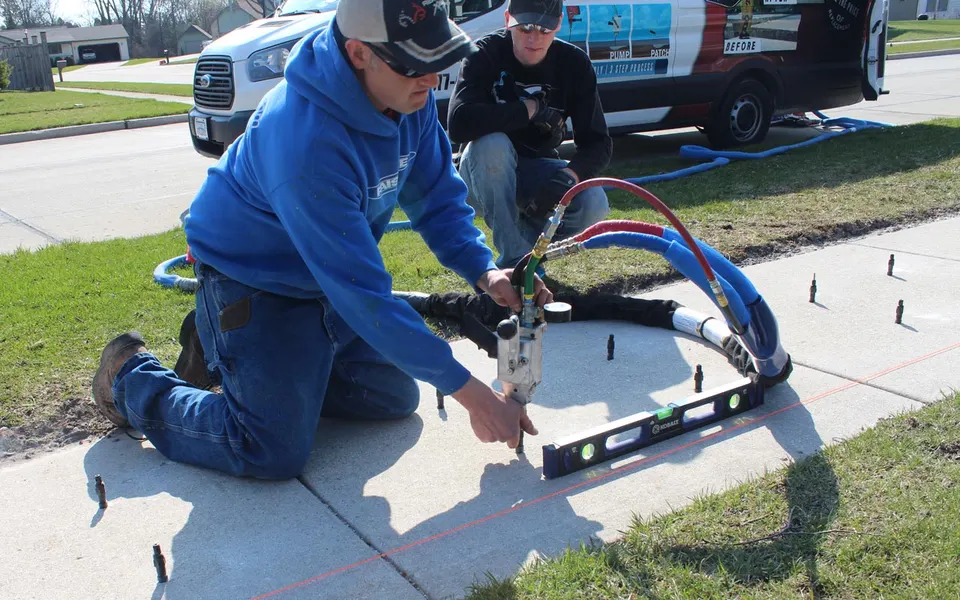
How Polyurethane Concrete Leveling Works
We drill a few dime-sized holes through the sunken slab, then inject expanding polyurethane foam beneath it. The foam flows into the voids under the concrete, fills them completely, and raises the slab back to grade as it expands. It cures in about 15 minutes, so we can check progress against a level as we work and stop the lift exactly where the slab belongs. When we finish, we patch the holes, and you can walk or drive on the surface the same day.
Polyurethane vs Mudjacking
Mudjacking pumps a sand and cement slurry under the slab through holes big enough to need serious patching. That slurry is heavy, so it bears down on the same soil that already gave way once, and it can erode again when water gets underneath. Polyurethane takes the opposite approach. The foam is lightweight, so it does not overload the soil. It is waterproof, so washout cannot carry it off. And it cures in minutes instead of days, which is why we hand the surface back the same afternoon.
What We Lift
If it is a concrete slab and it has settled, there is a good chance we can bring it back. The most common lifts we handle across the metro:
- Driveways and garage aprons
- Sidewalks and front walkways
- Garage and basement floors
- Pool decks and patios
- Porches, stoops, and steps
Why Minnesota Slabs Sink
Minnesota soil moves. Frost pushes slabs up through the winter, and they rarely settle back exactly where they started. Snowmelt and spring rain wash fine soil out from under the edges, leaving voids the slab slowly sinks into. A downspout dumping water next to the concrete speeds the whole process up. Leveling fills the void and fixes the symptom, and simple drainage corrections keep the problem from coming straight back.
Why homeowners pick us for concrete leveling
- Slabs are usable the same day, with foam cured in about 15 minutes
- Dime-sized injection holes instead of a torn-out slab
- Lightweight foam that does not overload the soil the way slurry does
- Waterproof material that will not wash out in spring melt
- A permanent lift that fills the voids causing the settling
- A fraction of the cost of full replacement
How the job runs
- Step 1 of 4
Inspect and measure
We walk the slab, find the low corners, and measure how far it has settled so we know exactly where the lift needs to go.
- Step 2 of 4
Drill
We drill a small pattern of dime-sized holes through the slab, placed so the foam reaches every void underneath.
- Step 3 of 4
Inject and lift
Expanding polyurethane foam fills the voids and raises the slab back to grade while we check the rise against a level.
- Step 4 of 4
Patch and clean up
We patch the injection holes, sweep the area, and the surface is ready for foot and vehicle traffic the same day.
What does concrete leveling cost in the Twin Cities?
Price depends on the size of the slab, how far it has settled, and how much void the foam has to fill. Access matters too: a backyard pool deck takes more setup than a front sidewalk. What holds across every job is that leveling runs a fraction of the cost of tearing out and repouring the same concrete, and it is done in hours instead of days. We measure the settlement in person and give you a firm number before any drilling starts.
Fair questions, straight answers
How long does polyurethane concrete leveling last?+
The foam itself is permanent. It is waterproof, it does not break down in soil, and it does not compress under normal loads, so the lift holds. If a drainage problem keeps washing soil out from under the slab, we point it out during the estimate so the repair lasts.
Is polyurethane leveling better than mudjacking?+
For most Minnesota slabs, yes. Polyurethane needs smaller holes, cures in about 15 minutes instead of days, and will not wash out because it is waterproof. It is also far lighter than slurry, so it does not press down on soil that has already proven it can fail.
How long does concrete leveling take?+
Most residential jobs run a few hours from setup to cleanup. The foam cures in roughly 15 minutes, so there is no waiting period afterward. You can walk on the slab right away and drive on it the same day, which is a big difference from replacement.
Can cracked concrete still be leveled?+
Usually. Cracked sections can often be lifted individually, then sealed so the surface reads as one piece again. If a slab is crumbling or broken into small fragments, replacement makes more sense, and we will say so during the assessment instead of selling you a lift that will not hold.