
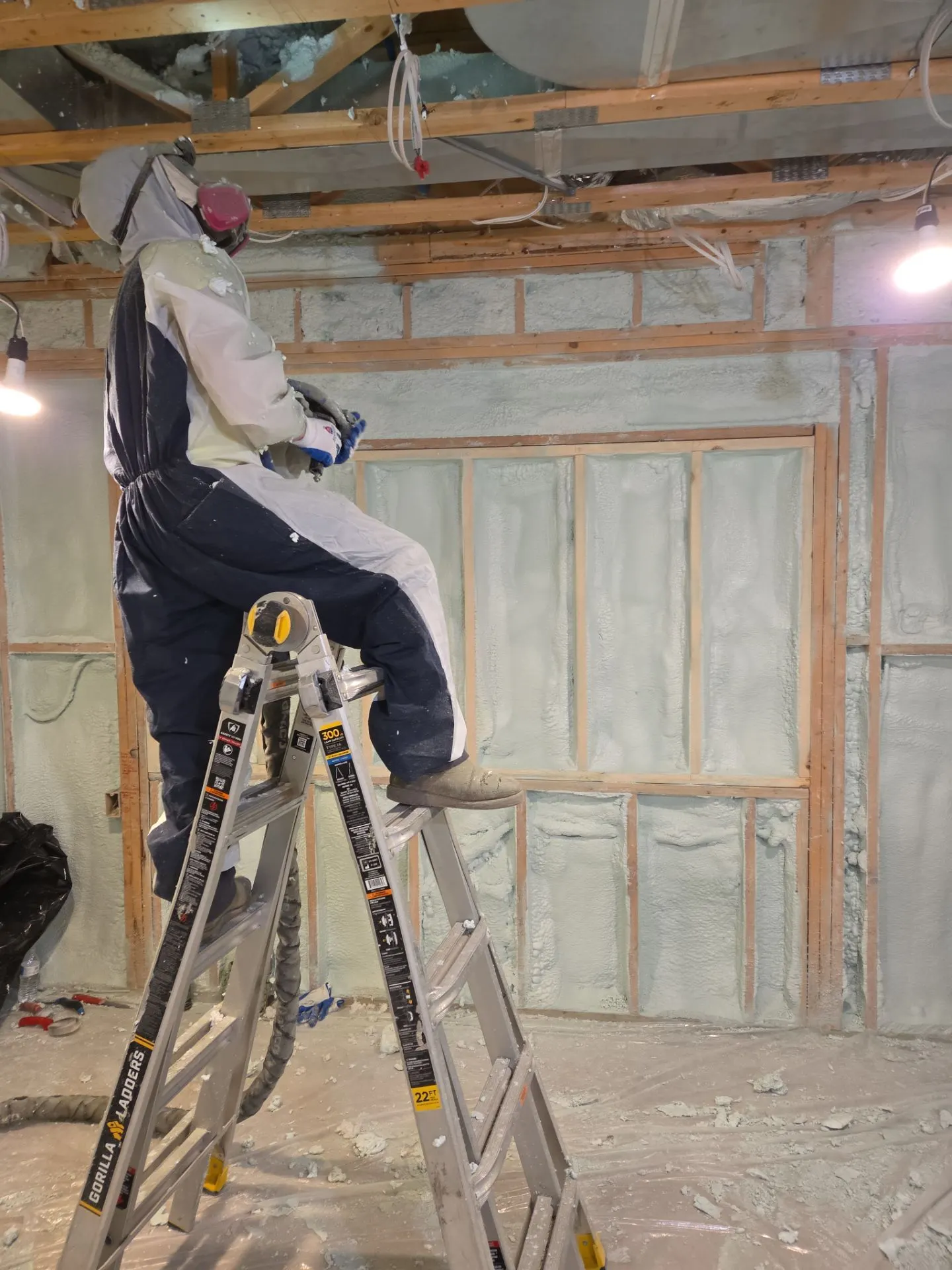
Open-Cell vs. Closed-Cell Spray Foam
The two foam types share the same expanding polyurethane chemistry but behave very differently once cured. Closed-cell foam cures dense and rigid. It resists water, adds structural stiffness to framing, and packs more R-value into each inch, which makes it the right call for rim joists, basement walls, exterior assemblies, and anywhere moisture is a concern. Open-cell foam expands softer and lighter. It costs less per inch, absorbs sound well, and fills odd-shaped cavities completely, so we use it in interior walls and open attic spans where there is room for a thicker layer. Many projects use both: closed-cell where the house meets soil and weather, open-cell where budget and sound control matter most.
- Closed-cell: higher R-value per inch, moisture resistant, adds rigidity to walls and rim joists
- Open-cell: more economical per inch, strong sound dampening, ideal for interior walls and attics
- Both types air-seal the cavity as they expand, which batts and loose fill cannot do
Why Spray Foam Fits Minnesota's Climate
Central Minnesota swings from -20°F winters to humid 90-degree summers, and that range punishes leaky insulation. Fibrous insulation slows heat but lets air move through it, so warm indoor air carries moisture into cold cavities where it condenses. Spray foam works differently: it air-seals and insulates in a single pass, and closed-cell foam adds a moisture barrier at the same time. That combination keeps heated air inside in January, keeps humidity out of wall cavities year-round, and takes the strain off your furnace and air conditioner during the extremes. It is also why spray foam does so much for ice dam prevention: when attic air stays sealed, the roof deck stays cold and snow melts evenly instead of refreezing at the eaves.
Where We Install Spray Foam
Rim joists are the most common starting point, because the band of framing where the house sits on the foundation leaks more air than almost any other spot, and two inches of closed-cell foam seals it for good. Beyond that, we foam attics and cathedral ceilings, garage walls and ceilings, basement and crawl space walls, and full new-construction shells. Pole buildings are a specialty around Monticello and Wright County: closed-cell foam bonds directly to steel skin and framing, controls condensation drip, and turns a cold shed into a shop you can heat affordably.
- Attics and cathedral ceilings
- Rim joists and band boards
- Basement and crawl space walls
- Attached and detached garages
- Pole buildings and shops
- New construction and additions
One Crew, One Chemistry
Foam-Tek does two things: spray foam insulation and polyurethane concrete leveling. Both trades run on the same expanding-polyurethane chemistry, so the crew that insulates your rim joist understands the material at a level most insulation companies never touch. We have been at it since May 2022, we are licensed and insured (MN License #IR797260), and our 51 Google reviews average 5.0. When we say the foam will do something, that comes from spraying it every working day.
Why homeowners pick us for spray foam
- Air seals and insulates in one application
- Highest R-value per inch available
- Closed-cell foam resists moisture and adds rigidity
- Cuts heating and cooling loads year-round
- Helps prevent ice dams by keeping attic air sealed
- Bonds to wood, steel, and concrete
How the job runs
- Step 1 of 4
Walkthrough and quote
We look at the actual assemblies, check for moisture or ventilation issues, and recommend open-cell, closed-cell, or a mix based on the building, not a sales script.
- Step 2 of 4
Prep and masking
We mask off floors, windows, outlets, and anything else that should not catch overspray, and confirm the work area is ready before the rig starts.
- Step 3 of 4
Spray and trim
Foam goes on in controlled lifts to the specified depth. Once cured, we trim any proud spots flush so drywall or finishes go on clean.
- Step 4 of 4
Inspection and cleanup
We check depth and coverage across the whole job, walk it with you, and haul out masking and trimmings so the site is ready for the next trade.
What does spray foam insulation cost in the Twin Cities?
Spray foam pricing depends on the foam type, the square footage and depth being sprayed, and how much prep the space needs. Closed-cell costs more per inch than open-cell but delivers more R-value and moisture protection per inch. Access matters too: an open new-construction wall sprays faster than a tight crawl space. Rim joist jobs sit at the small end, full attics and pole buildings at the larger end. We quote every project from a walkthrough, so the number reflects your building instead of a per-foot guess.
Fair questions, straight answers
Is spray foam safe for my family?+
Yes, once it has fully cured. Spray foam is applied by a trained crew wearing protective gear, and the home needs to be vacated and ventilated during application and for a short cure window afterward. After curing, the foam is inert and stable. We walk you through the re-entry timing before we spray so there are no surprises.
What is the difference between open-cell and closed-cell spray foam?+
Closed-cell foam is dense, moisture resistant, and delivers more R-value per inch, so it suits rim joists, basements, and exterior assemblies. Open-cell foam is lighter, costs less per inch, and absorbs sound, so it suits interior walls and attic spans. We often combine both on the same house based on what each assembly needs.
Does spray foam help with ice dams?+
It is one of the best tools for the job. Ice dams form when warm attic air melts roof snow that refreezes at the cold eaves. Spray foam seals the air leaks that let heated air into the attic in the first place, keeping the roof deck cold so snow melts evenly instead of ponding as ice.
Can you spray foam a pole building or shop?+
Yes, and we do it often around Monticello and Wright County. Closed-cell foam bonds directly to steel panels and posts, stops condensation from dripping off the ceiling, and makes the building practical to heat. Most shop owners tell us the difference is obvious the first cold week after we spray.
How long does spray foam insulation last?+
Properly installed spray foam lasts the life of the building. It does not settle, sag, or lose R-value the way loose fill and batts can over decades, and closed-cell foam is unaffected by incidental moisture. The key variable is installation quality, which is why depth checks are part of every job we finish.