
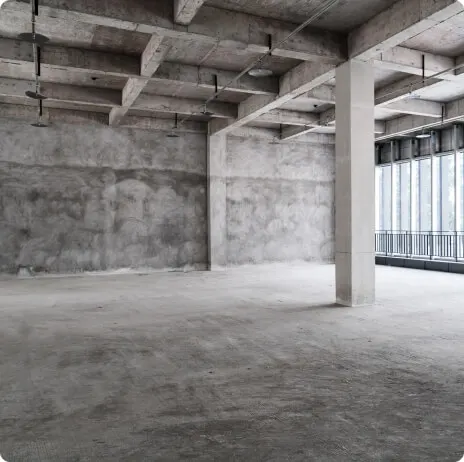
Basement Floor Leveling
Basement slabs are usually poured over backfill, and backfill settles for years after a house is built. When the soil drops, the slab follows, and in a finished basement the damage shows up fast: flooring that slopes toward one wall, doors that swing on their own, cracks telegraphing through tile or vinyl. The stakes are higher indoors because everything you own sits on that slab. We lift the floor back to level through dime-sized holes, working around the finished space instead of through it.
Garage Floor Leveling
Garage slabs settle toward the overhead door for the same reason driveway aprons do: the soil at the foundation edge was disturbed during construction and keeps compacting. A tipped garage floor sends snowmelt toward the foundation instead of out the door, and the crack patterns that follow only widen with each freeze. Lifting the slab restores the original pitch so water drains out where it should, and the foam fills the voids so the floor stops moving.
A Clean Indoor Process
Interior work has to be tidy, and this process is built for it. There is no slurry sloshing through your basement and no wheelbarrows of concrete coming down the stairs. We drill small holes in the slab, run a hose from the truck, and inject foam in controlled shots while watching the lift against a level. The foam cures in about 15 minutes, the holes get patched flush, and we clean up behind ourselves. Most interior lifts are done inside a day.
Why homeowners pick us for interior floor leveling
- No jackhammers, tear-out, or dumpster in the driveway
- The floor is walkable the same day the work is done
- Only a hose comes inside; the equipment stays on the truck
- Lightweight foam will not overload the soil under the house
- Restores drainage pitch on tipped garage floors
- A fraction of the cost of breaking out and repouring the slab
How the job runs
- Step 1 of 4
Evaluate the slab
We measure how far the floor has settled and where, then plan injection points that avoid finished areas wherever possible.
- Step 2 of 4
Prep the space
Work zones get protected, small sections of floor covering are pulled back where needed, and dime-sized holes are drilled.
- Step 3 of 4
Inject and monitor
Foam goes in through a hose from the truck, filling voids and raising the slab in small, controlled increments.
- Step 4 of 4
Patch and hand back
Holes are patched flush with the floor, the space is cleaned, and the slab is ready for normal use that day.
What does interior concrete leveling cost in the Twin Cities?
The drivers are the size of the settled area, how far the slab has dropped, and how much prep the space needs. A bare garage floor is simpler than a finished basement where flooring has to be pulled back at each injection point. Voids under the slab add material, so deeper settlement costs more than a shallow dip. Against the alternative of breaking out an interior slab, hauling it up the stairs, and repouring, leveling is a fraction of the price and a fraction of the disruption. We quote after seeing the floor.
Fair questions, straight answers
Can you level a basement floor without wrecking the finished space?+
Yes. We need access to bare concrete at each injection point, so small sections of flooring get pulled back rather than removed wall to wall. The holes are dime-sized, the foam arrives through a hose from the truck, and there is no slurry or demolition debris moving through your house.
Why is my basement floor sinking?+
Most basement slabs rest on backfill soil that was placed during construction, and that soil keeps compacting for years. Water from footing drains, plumbing leaks, or outside grading can wash fines out from under the slab too. The concrete settles into the resulting voids, which is what we fill and lift against.
How long does an interior leveling job take?+
Most garage and basement floor lifts finish within a day, including prep and cleanup. The foam cures in about 15 minutes, so there is no waiting for the slab to be usable. You can walk on the floor as soon as we patch the holes, and put rooms back together the same evening.
Is foam safe to use under a home?+
The cured polyurethane is inert, waterproof, and stable, and it is the same chemistry we use for insulation work. It does not attract pests or hold moisture, and because it weighs far less than a slurry fill, it does not add load to the soil supporting your foundation.