
Trip Hazards Are a Liability
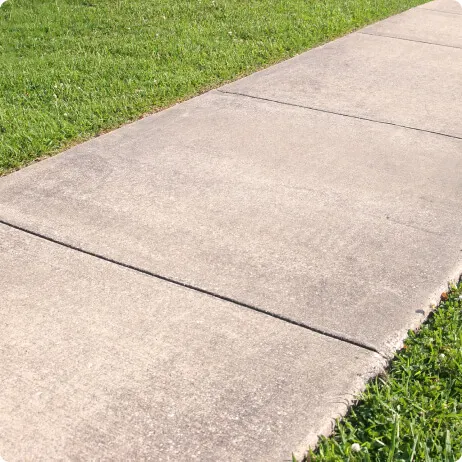
A raised sidewalk edge is more than an eyesore. For a homeowner, it is the spot where a guest, a mail carrier, or a kid on a scooter goes down in front of your house. For a homeowners association or property manager, settled common-area walkways are a standing liability that gets worse each winter as frost pushes the panels further out of line. Leveling closes the offset the same day, without weeks of orange cones around a fresh pour.
City Sidewalk Rules Vary
Many Minnesota cities inspect public sidewalks and notify property owners when a panel needs attention, but the programs, standards, and cost arrangements differ from one city to the next. If you have received a notice, check the specifics with your city first. In many cases, raising the settled slab back to grade addresses the offset the notice describes, at far less cost and disruption than tearing the panel out. We are glad to look at the walk and tell you whether a lift will get it back within tolerance.
How We Lift a Sidewalk
We drill dime-sized holes in the settled panel and inject expanding polyurethane foam underneath. The foam fills the voids that frost heave and washout carved out, then raises the slab until it sits flush with the next panel. It cures in about 15 minutes, the holes get patched, and the walkway carries foot traffic again the same day. Because the foam is waterproof and lightweight, the repair does not wash out or press the soil into another round of settling.
Why homeowners pick us for sidewalk leveling
- Trip hazards gone in a single visit
- The walkway reopens the same day, no curing period
- Small patched holes instead of a mismatched new panel
- Waterproof foam that holds through freeze-thaw cycles
- Works for single homes, associations, and commercial walks
- A fraction of the cost of removing and repouring panels
How the job runs
- Step 1 of 4
Walk the route
We check every panel, measure the offsets, and note which slabs need lifting and which just need joint sealing.
- Step 2 of 4
Drill small holes
Each settled panel gets a few dime-sized injection holes placed to reach the voids beneath it.
- Step 3 of 4
Raise the panel
Foam expands under the slab and lifts it even with the surrounding panels while we monitor the rise with a level.
- Step 4 of 4
Patch and reopen
We patch the holes and sweep up. The walk is back in service before we leave the driveway.
What does sidewalk leveling cost in the Twin Cities?
Cost tracks with the number of panels that need lifting, how far each has settled, and how much void sits underneath. A single offset panel at the front step is a small job. A full association walkway with a dozen settled slabs is a larger one, though the per-panel cost usually improves at that scale. Either way, leveling runs a fraction of what removal and replacement costs, and nobody waits a week for concrete to cure. We measure on site and quote before we drill.
Fair questions, straight answers
Can a sidewalk trip hazard be fixed without replacing the slab?+
Yes, in most cases. We inject expanding polyurethane foam under the settled panel and raise it flush with its neighbors, which removes the offset entirely. Replacement only becomes necessary when a panel is shattered or badly deteriorated, and we will tell you honestly if that is what we find.
Why did my sidewalk settle in the first place?+
Minnesota frost lifts sidewalk panels every winter, and they seldom drop back exactly into place. Meltwater and rain then wash fine soil out through the joints, leaving voids under the slab. The panel sinks into that empty space a little more each season until an edge sticks up next door.
Does leveling work for HOA and association walkways?+
It is one of the most practical repairs an association can order. We can lift multiple settled panels across a property in a day or two, walkways stay open for residents the whole time apart from the panel being worked, and the finished slabs match the existing concrete instead of standing apart as new pours.
Will a lift satisfy a city sidewalk repair notice?+
Often, but every city writes its own rules, so confirm the requirements on your notice first. Most notices target the offset between panels, and raising the settled slab back to grade removes that offset. We can look at the notice with you and say whether a lift will bring the walk within the stated tolerance.